Good morning and welcome back to The Homeplace 1850. The people during the time period worked very, very hard to survive. The woman of the house would probably be preparing a hearty breakfast of country ham and red eye gravy. Perhaps leftovers from the previous day's meal would be fetched from the pie safe and included in the morning meal. Thousand of calories would be expended in the course of a day of working in the fields or engaged in the other activities of daily life.
The Homeplace was and is worked by the seasons. In other words, the tasks were determined by the seasonal requirements.
In the spring the fields would be plowed using horses or mules. Corn was the most important crop. Sweet corn was unknown in those days. Corn was the grain of choice because all the farm animals ate corn and it was the only grain served on the table.
Behind the dogtrot house the women planted the vegetable garden.
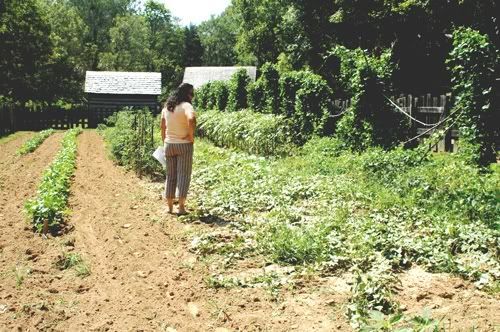 Modern day gardener inspects the 1850 vegetable plot.
Conspicuously absent from this garden are tomatoes, which were thought to be poisonous. Only the most educated people knew that tomatoes were not poisonous but even they were reluctant to take a chance. Fresh spring greens would be gathered from the surrounding countryside. We think of them as weeds but plants such as lamb's quarter, dandelion and curly dock gave some variety to their meals before the vegetables had a chance to mature.
In the spring the family and neighbors would have a celebration, roasting a shoat (a young pig) over an open fire.
A short distance behind the main dogtrot cabin is the spring house. This structure was built on the creek. This was the family's refrigeration system. The cool water of the creek would keep eggs and milk fresh longer.
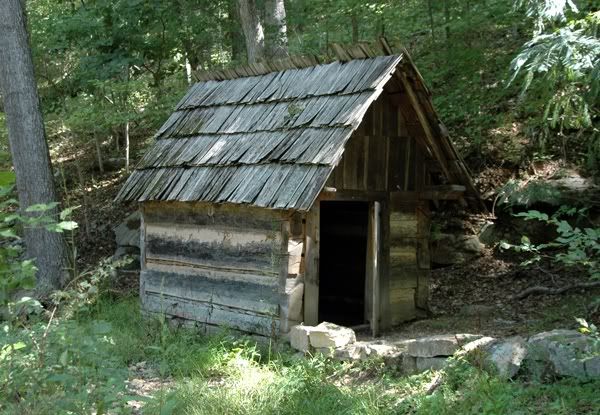 Spring house.
Unfortunately on this day the creek is dried up. It leaves you to image what difficulties the weather and nature could cause for these settlers.
Beyond the spring house is the hog pen.
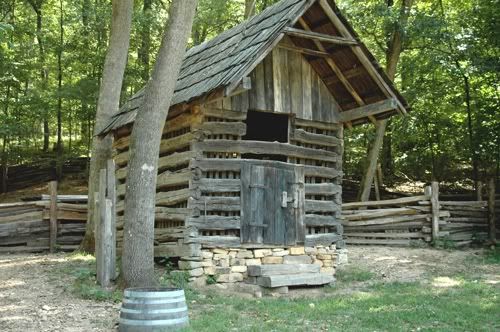 Hog pen, unchinked.
Unlike the dogtrot cabin, you'll notice that the hog pen is not chinked. There's is no material between the logs, allowing air to flow through.
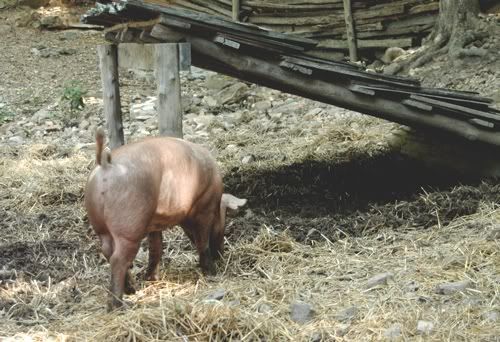 Homeplace hog.
Hogs were extremely important to the survival of the settlers. Without a hog or two to butcher in the fall, their survival through the winter would be doubtful. This is mentioned in the book Cold Mountain and the journals and diaries from the 1800's.
By necessity these were very ingenious and resourceful people. My sister and I could only speculate on this planting. What do you think? It's a round wattle fence with some type of squash planted inside.
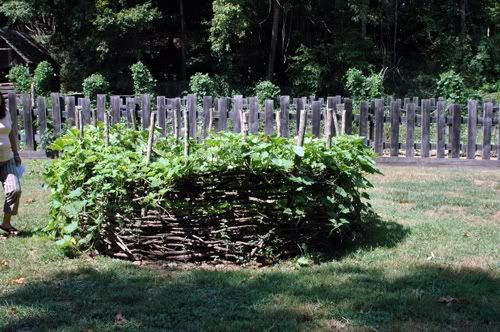 Round wattle fence and squash.
Our theory is that it is meant to keep animals from eating the squash and also to keep the squash from taking over the barnyard!
Here's the smaller cabin further down the hollow.
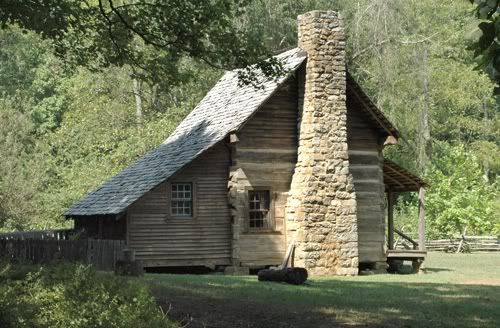 Traditional cabin.
This is a smaller and more traditional cabin. It's only one story. That's the kitchen lean-to in the back. Again, if the kitchen catches on fire, the entire cabin will burn to the ground. The interior is a small and cozy space.
We're going to spend one more night at The Homeplace. This is our bed for the evening. Again, piled high with featherbed.
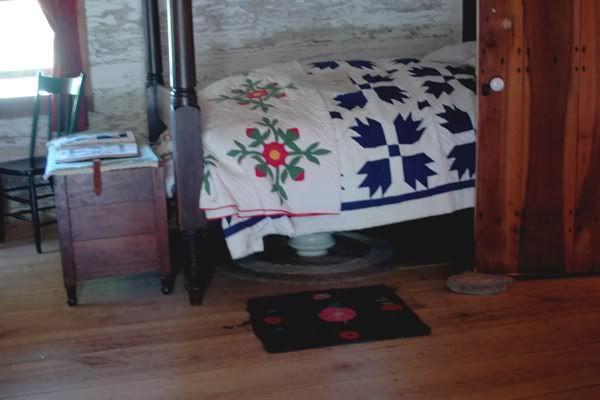 Settler's bed with quilt.
Notice the white porcelain bowl shaped object under the bed. You know what that is for, right? And again, this is not ancient history. When I was a kid my aunt and uncle (the tobacco farmer) did not have indoor plumbing. A trip to the outhouse in the dead of night was not an option. Use your imagination. Think you couldn't use it? Think again. HA.
You'll notice something else sitting on the chest at the end of the bed. The woman of the house has put together a collection of quilt square samplers. Feel free to examine the book by candlelight.
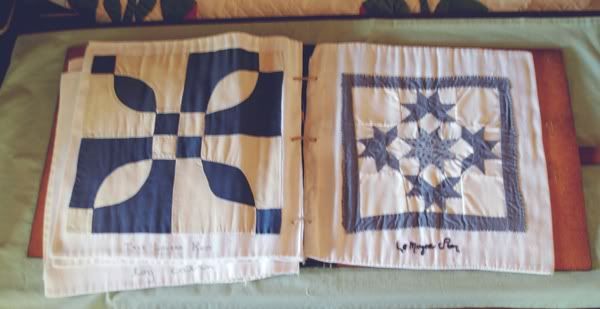 Quilt sampler.
Have a great night's sleep in the pitch dark and quiet night in 1850.
- - - - - - - - - - - - - - - - - - - - - - - - - - - - - - - - - - - - - - - - - - - -
Country Ham and Red Eye Gravy
4 slicesa country ham, 1/4 inch thick
1 cup cold strong coffee
Trim the excess fat from the hame slice. Rub the bottom of a cast iron skillet with the ham fat, greasing it thoroughly. Heat the skillet on high heat until it's very hot. Turn down the heat a bit and add the ham slices. Sear on both sides.
Pour the coffee into the skiullet and bring to a boil. Lower the heat and simmer gently for 10 minutes, or until the ham is tender. Most of the gravy will have cooked away but there should be enough left to coat the ham. Serve immediately with hot biscuits.
Four servings.
NOTE: Historical information and recipes gleaned from a cookbook published by The Homeplace 1850. I don't believe it's still in publication.