Tuesday, September 28, 2010

You know you've had a successful vacation when......

..... you are relaxed and rejuvenated.

AND.... you have to mail a box home because all your "stuff" will no longer fit in your suitcase.

That's because I've acquired new and different stuff at the Treasure Sale at one of the local churches. The box is filled with vintage aprons, a large crocheted piece, bridge cloth and napkins, a set of vintage square dance figuirines, yarn and more! You know I'm a sucker for aprons. Oh, and a large vintage figuirine of mother-and-child. I'm also a sucker for vintage religious icons. They live on the top shelf of the bookcase in my sewing room.

So, it's off to the post office this morning to mail the box. I paid $13 for all the items. Let's see what it costs to send them home!


Sunday, September 26, 2010

The Rest of the Story

The American Tenors concert was wonderful but there's more to the story. Isn't there always more to every story?

It's true, I put the convertible top down and drove in the dark, cool night under a full moon but it wasn't just to enjoy the evening air and starry night. The rest of the story is that I was gagging for some fresh air. You see, the concert was held in a very modern auditorium in a retirement community.

Do you know what that means? It means that the venue was filled to the rafters with elderly women.

Elderly women bathed in clouds of heavy perfume. I'm talking heavy perfume of many types. The result was an oppressive fog. I'm wondering how the tenors windpipes could survive such an onslaught of chemicals.

I've said many times that anyone over 60 should probably not wear perfume, me included! Something changes in our body chemistry and BOOM.... when perfume hits the skin it transforms into something unintended.

Perhaps women should be carded at the perfume counter, limited to a watered down version of a light scent.

I've given up wearing perfume except perhaps a light spritz of CK One which I spray in the air in front of me and quickly run through.

But Wednesday night? Wednesday night I was in "White Linen Hell".

How about you? Do you wear perfume? Do you have a signature scent? I worked with a woman who only wore "Nude" by Bill Blass. It is a very distinctive scent and she wore it sparingly. You could get the slightest hint and know that she was somewhere nearby.


Friday, September 24, 2010

Anybody Home??

I'm still here, south of the Mason-Dixon line.

Hey, have you ever wondered about the Mason-Dixon line? Mason and Dixon were surveyors who were handed the task of settling a border dispute at a time before the American Revolution. The line eventually became known as the line that divides the northern states from the southern. Anyway, south of the Mason-Dixon line they have some great mayonnaise... and grits... and flour.

They also put on some great concerts. My mom and I attended a performance on Wednesday night that had me wondering what we'd do if someone hadn't invented music. We saw The American Tenors and they were absolutely wonderful.

The group is comprised of three tenors; Ben Gulley, Marcus McConico and Nathan Granner. The concept of the American Tenors was the brainchild of Irish musician and producer, Frank McNamara. He served as the accompaniest for the evening.

I can't say I've ever been a fan of opera but if you hear an operatic tenor singing their best, they'd make a believer out of you.

After the concert we put the top down on the convertible and sat in the dark waiting for the rush of cars to leave the parking lot. And then we drove through the forest under a full moon. We drove and hummed the tunes we'd heard.

I was in the moment and thankful for wonderful artists who share their talents.

THE AMERICAN TENORS

NATHAN GRANNER

Friday, September 17, 2010

And They Call the Wind Nonexistent

My mom and I were enjoying dinner on the deck last night. We feasted on raspberry chipotle pork tenderloin and sauteed zucchini. It was delicious. House and dogsitting for our friends is like staying in a do-it-yourself bed and breakfast and it's wonderful. I don't mind cooking some meals, making the beds and caring for the dogs in return for staying in a cool place for two weeks.

The great thing is that even though there are some tasks, it's just not like at home where, over coffee my mind is immediately processing all the thing that need to be done in my own home. We have a large home on a large piece of property and there's an endless list of projects that are stored in my mental file cabinet. Over breakfast the dam breaks and I'm forced to choose and confront a daily project. Here, the pressure is off. Phew!

Last night sitting on the deck I observed the trees. Basically we're staying in the middle of a forest. This land was once Weyerhauser property and it's a dense forest of very tall trees. This is a change for this Illinois flatlander. Don't get me wrong, there are lots of very large trees in my area but not in such density.

As I relaxed and watched the forest I noticed a strange thing, strange for me at least. The air was not moving. Not one molecule was moving. In northern Illinois this is a rare occurrence. I can't say I seen a dead calm more than a few times and usually it meant disaster was close behind. When the air gets deadly still in Illinois there's probably a tornado close behind. What it means in central Arkansas is that you're going to have a sticky hot evening.

As I watched the canopy, a tiny leaf moved, almost inperceptibly. Then a few more leaves joined in as tiniest puff of air riffled through a small area at the top of an oak tree. No wide gusts of wind, just small eddys.

I suppose in northern Illinois we are conditioned to expect the blasts of air and we're not conscious of the part they play in our landscape. Only when they're absent are we shaken into awareness.


Wednesday, September 15, 2010

The Farmer's Wife - Southern Edition

We arrived safely yesterday afternoon. It was what I call an up-and-down flight, only a little over an hour and a half from Chicago's O'Hare Airport to Little Rock. At this point I must comment on O'Hare. In addition to being one of the world's busiest airports it is also one of the cleanest and most modern. Little Rock's airport is very nice also and it's greatest beauty is the fact that it's small and you can get in and out in a flash. O'Hare is HUGE and you must allow goo-gobs of time before your flight. I'm sad to say that I'm old enough to remember when O'Hare was nothing but a national guard air base and a race car speedway! Yeah, THAT OLD!

While we're housesitting for our friends and caring for their beautiful rescued Greyhounds we have the use of their cars, including a candy apple red metallic PT Cruiser convertible. Yes, a convertible. I'll have to say that I look adorable driving that car. And here's the beauty of the internet, I can paint that picture in your mind and you can believe it (or not!). Hey, a person has to be allowed their dreams, right? We'll in my dreams I look adorable.

Old, but adorable.

I'm going to mention once again the thought that geographical areas have a certain scent, I'll call it the eau-de-locale. For me, the south is an earthy mixture of sand and pine needles. Very distinctive. It's very strong in the Florida panhandle and in parts of Alabama. Perhaps because I live in the rural midwest I'm immune to the "eau". Perhaps it's a blend of corn stalks and cow manure. HA!

At this moment I'm sitting in my friends office looking out the window at her gorgeous magnolia tree. The leaves are the glossiest green, as if they'd been carefully polished in the middle of the night. The bloom pods are the most interesting large oval shapes with overlapping layers, reminiscent of the cap of an acorn.

Ah.... acorns. That brings me to the subject of winter. I'm thinking this is going to be a fearful winter. The squirrels back in Illinois are engaged in frenetic nut burying activities. Honestly, I've never seen anything like it. They act as if they're hopped up on drugs. Everyone is commenting on this activity. Stay tuned. The snowblower has fresh gas and is ready to go. Hopefully we can hold off the snow until after Thanksgiving.

Mom and I had tater tots with chili and cheese at the local Sonic drive-in. To wash it all down I had an orange Creamsicle shake. I raised my glass and made a toast to you. This evening I'll do the same with a Tanqueray and tonic at the local watering hole where we'll meet up with some friends.

I hope everything is well in your world. Thanks for taking time out of your busy day to visit with me. I always appreciate your company!

P.S. Sorry, no photos. I don't have the capability to load and process photos on this computer. I'll attempt to paint pictures with words.

Monday, September 13, 2010

Gone Fishin'

My mom and I have left for a two week vacation together. We're going to be housesitting for some friends and it will be some together time for the two of us.

I'll have access to a computer but I can't promise anything and certainly there will be no photographs until I return.

The past few days have been spent preparing for the trip, doing orientation for the new job and moving all my blog feeds to Google Reader. In case you haven't heard, Bloglines is shutting down. I'm curious as to how you manage the list of blogs that you follow. Bloglines states that the writing was on the wall concerning feed readers and that everyone is using Twitter.

Really?

Everyone?

That must mean I'm no one because I don't Twitter, I don't tweet and I guess the world is passing me by once again.

Behave yourselves while I'm gone. Feel free to conduct a Monday Morning Staff Meeting without me!

Saturday, September 11, 2010

In Remembrance - William Wren

Several years ago I became a part of something called Project 2996. Each person who agreed to participate was given the name of someone who perished on September 11. Since that time I remember William Wren and his family on this day.


In remembrance -

William Wren - age 61
Resident Manger - OCS Security
Confirmed Dead - World Trade Center

William Wren, a retired New York City firefighter, worked for OCS Securiy as fire security officers in the World Trade Centers.

Raised in Gerritsen Beach in Brooklyn, Wren graduated from James Madison High School, served three years in the U.S. Army and joined the New York City Fire Department. People remember him as a quiet, reserved man who never spoke of his firefighting adventures.

The New York Port Authority contracted with OCS as part of the additional safety precautions that were put into place after the 1993 World Trade Center bombing. Five employees of OCS died on September 11, including Wren's neighbor of over thirty years, Richard Fitzsimons.

Both men were at work on that morning and Wren called his wife Pat shortly after 9 a.m. to say he was OK. But sirens were wailing in the background. Ten minutes later he called back to say that Richard was also OK and that Pat should call his wife and let her know.

That was a last time either family heard from the men. It is known that they continued to perform their duties, along with the other OTC employees who were lost - Philip Hayes, Larry Boisseau and Robert Mayo. They evacuated the day care center first, and with their intimate knowledge of the building continued to evacuate and bring others to safety.

These are just the barest facts of his life and his actions on that day. To tell his whole story, the story of his life and his death, would take an entire book. There are those who can remember him as the man who saved their lives. How would you ever repay a debt of that magnitude? You could remember.... and vow to live your life with the caliber of character exhibited by this man.

Just people..... just doing their jobs....thrust into extreme circumstances. Everyday heroes.

I want William Wren's wife Pat and their children to know that they are in my thoughts and prayers and that we will never forget their loved one or their loss.

A story published September 15, 2001 - The families waited.

Thursday, September 9, 2010

The Hospital Socks and other Tales of Comfort

Recently I participated in Craft Hope's latest effort, the Pillowcase Project in conjunction with the ConKerr Cancer Group.

It was my pleasure to be able to use my sewing skills to put together several pillowcases to donate to this cause. I wondered though, what could possibly be the impact of a pillowcase on someone's life? It is, after all, just a piece of bed linen.

Kids and parents have written letters thanking the participants for the pillowcases and it occurred to me that I needed to take their word for the fact that, even though it was a small gesture, it was important to them.

And then the weather turned chilly and, as is my habit when the air turns cool, I walked to my dresser and opened the third drawer from the top. I reached inside and pulled out my hospital socks.
Photobucket


For a moment I stood in my bedroom with the slighly shabby socks in my hand, and I became fully aware of the importance of those pillowcases.

The hospital socks. What's the story behind them?

Several years ago I went to the hospital to have a procedure done. It was the procedure that everyone dreads. The one that involves a full day of drinking yucky stuff and living in the bathroom. Yeah, that procedure. No matter how many people tell you that the preparation is terrible and the test is nothing, the anxiety level still rises as you drive up to the hospital.

I found myself in a waiting area, with nothing but curtains separating my space from the other patients. A physician sat across the hall and droned on incessantly into a recorder, unaware that the open door and the echoing hallway was destroying all HIPPA legislation. Yes, I was privvy to everyone's procedure results!

The Farmer sat with me and we chatted, but still I felt very alone. I could not imagine what goes through the minds of people who are laying on these beds facing serious health issues. It just felt lonely to me.

The room was cold. I just remember how cold and lonely it felt. The staff was friendly. They were simply going about their tasks in a professional manner but I was acutely aware that this space did not hold the security of home.

And then a nurses aide pulled the curtain back, cradling in her arms a clean, white blanket. She carefully laid it across the sheet that covered me and I was surprised. It was warm. It was so warm and soft.

"Why is this blanket so warm?" I asked.

"Oh, we have a special warming cabinet."

Imagine that. I'm sure the Farmer would approve the purchase of something so wonderful as a warming cabinet.

A few minutes later the aide returned with the pair of hospital socks. I wasn't too sure I wanted to put on a pair of socks but the Farmer helped me slip them on and something strange happened. I felt cared for. Those silly blue green socks with the non-slip bottoms made me feel cared for.

Photobucket

They instantly became a totem for me. Crazy as it may seem I told myself that nothing bad could befall me as long as I had my hospital socks.

The procedure was performed and slowly I recovered from that crazy anethesia. The nurse had me get dressed and put my hospital socks in a bag to take home.

And there they reside, in the third drawer from the top, waiting for a chill to fill the air. I pull them out and instantly I can recall that warm and safe feeling.

Photobucket

And so, I had my answer. Yes, a pillowcase can make a difference for a child. In an insitution where it would be easy to lose their identity, slowing becoming "just a patient", a colorful pillowcase can become their own individual statement. And when they lay down to sleep, hopefully they can capture a warm and safe feeling for themselves.

Wednesday, September 8, 2010

The Good News and the Bad News

First of all, thanks to all of your for your positive thoughts. Thanks to them I have an announcement to make.

First the good news.

I got the job.

And the bad news?

I got the job.

The good news is that I'll have a regular paycheck. This is something that is iffy when you're an entrepreneur selling on Etsy. The bad news is that the job is at a large fabric and craft store.

You're all aware of my addiction. It's been well documented.

Here.

Photobucket
Right hand bookcase filled with fabric.

And here.

Photobucket
Left hand bookcases filled with more fabric.

And there's more.

Photobucket
Men's shirts, processed and stored in the closet, waiting to be turned into aprons.

That's one wall and the closet. I ran out of room and store MORE fabric in the little alcove in another bookcase.

Photobucket
Overflow bookcase with decorator fabrics and larger yardages.

Unfortunately, my shipping department, which is tucked in the corner, exploded and created this mess. Don't tell OSHA.

Photobucket

99.9% of this fabric was purchased that last time I worked in a fabric store. Did I mention that the new employer also sells yarn?

Photobucket

Oh yeah, another addiction.

Photobucket

There's lots stored in my closet with those men's shirts. Getting a job at a fabric and craft store is like giving an addict the keys to the pharmacy. Something like that.

You gotta admit that I've organized my obsession. It was necessary because the whole thing was getting away from me. But this creates another problem. The desire to keep it organized means that I've developed another obsession!

And so it goes.........

The job includes a discount and I've made a loose promise to myself that I'll only buy deeply discounted merchandise and only in a color I might not already have. Can that be possible?

Tuesday, September 7, 2010

Monday Morning Meeting on Tuesday

Good morning everyone. I hope you had a great Labor Day weekend. You know what that means though, summer is over! And you can't wear white unless you follow a set of ancient rules. Does anyone remember what they are?

- - - - - - - - - - - - - - - - - - - - - - - - - - - - - - - - - - - - - - - - - - - - - - - - -

Usually the first order of business is food. But this morning I got nothing for you. Why? Because all my spare time is spent with my new obsession. No, not fabric..... a stupid online game called Marble Frenzy. Have you tried it yet? I'm hesitant to provide a link lest your family go unclothed and unfed.

MARBLE FRENZY

There, now I've gone and done it.

- - - - - - - - - - - - - - - - - - - - - - - - - - - - - - - - - - - - - - - - - - - - - - - -

Those of you who have followed my adventures for a while will remember my commitment to reviewing "fair food", that is, food that is sold at the county/state fair. There's lots of food-on-a-stick and deep fried silliness.

Here are the deep fried oreos.
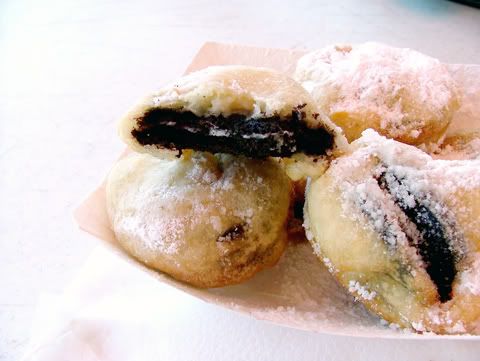
Image hosted by Photobucket.com

They were actually very good. The chocolate cookie part got soft like cake and the filling melted, imbibing the treat with sweetness. Thumbs up for the deep fried oreos.

I can't say the same for the deep fried Snickers bars. A bit too sweet and gooey for my tastes.

But, here's a story about the ultimate in deep fry madness.

DEEP FRIED BUTTER

I know. Foodies who have tried this concoction say thats it's very, very good. Something like a well buttered dinner roll. The article lists other state fair offerings. The deep fried Texas pecan pie just sounds like too much of a good thing but I'd like to try the deep fried peaches and cream with a side of vanilla buttercream icing for dipping. YIKES!

- - - - - - - - - - - - - - - - - - - - - - - - - - - - - - - - - - - - - - - - - - - - - - - -

I friend of mine gave me a great idea for an item to be produced and sold in my Etsy shop - old-fashioned clothes pin bags. Hanging clothes out to dry seems to have gone by the way of the dinosaurs around here, but I bet there's plenty of people out there who dry their clothes on a line.

My mom had a cute apron that had large pockets to hold the wooden pins and her friend had a clothes pin bag that hung on the line. After drying the clothes on the line my mom would bring them inside and sort those that didn't need ironing and those that did. The fabrics in those days were not permanent press and so the ironing pile was very high.

She would sprinkle the clothes with water from a large glass bottle that had a cork and sprinker head. Since she couldn't posssibly iron all those clothes in one session, she'd roll them up and tuck them in plastic and store them in the fridge until she could get to them. Does anyone else remember this?

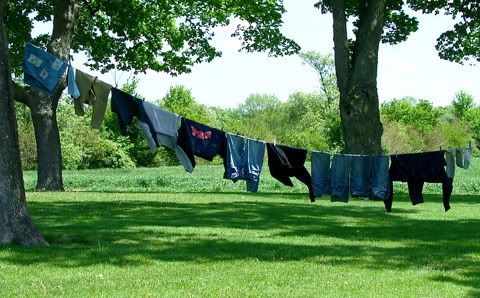
It was a funny coincidence that my friend mentioned the clothespin bag because just the day before I had been driving through a very upscale neighborhood in a nearby town. We're talking very upscale and snooty. I almost slammed on the brakes when coming around the corner of a beautiful tree-lined street filled with expensive homes I saw clothes hanging on a line!

The woman of the house (or perhaps her maid) had strung a line across the patio, from the house to the garage, and on the line was the family's laundry, gaily flapping in the breeze like Buddhist prayer flags.

Knowing the area I'm sure this did not sit well with the neighbors. There are all kinds of covenants and rules, said to protect the value of their properties.

Personally I love the look.
Photobucket - Video and Image Hosting

How about you? Do you dry your clothes on a line? How do you store your clothespins?

- - - - - - - - - - - - - - - - - - - - - - - - - - - - - - - - - - - - - - - - - - - - - - - -

We've all heard of money laundering but this is a new one on me...... honey laundering.

Really.

There's a scam that launders honey! Read about it in the Beekeper's Buzz.

HONEY LAUNDERING SCAM

There were also articles about this problem in the London Sunday Times and Mother Nature Network.

It seems the Chinese are finding ways to "launder" the honey to prevent paying tariffs but even more troubling is the fact that it's an attempt to slip tainted honey into foreign markets. Honey traced to China (through investigative efforts) has been found to contain antibiotics and pesticides.

Photobucket

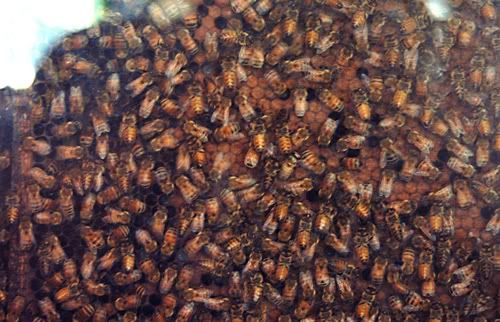
That's just another reason to buy local. I buy my honey at Heritage Prairie Market where you can not only meet and speak to the bee keeper, you can watch the hive at work.
Photobucket

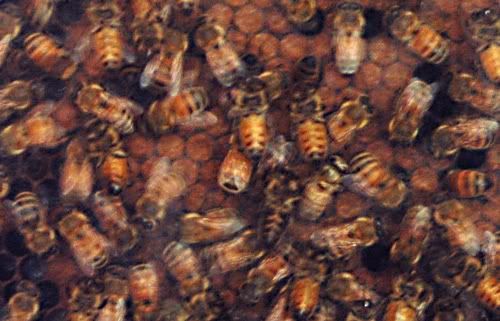
They've installed a window on the hive and you can watch them work from inside the store.
Photobucket

It's very interesting.

- - - - - - - - - - - - - - - - - - - - - - - - - - - - - - - - - - - - - - - - - - - - - - - -

And now I'll announce the winner of the handmade luggage tag.
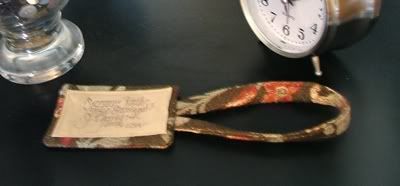
Photobucket

And, the winner is....

BAILIE

Just send me an e-mail with your address and I'll get the luggage tag in the mail.

Thanks everyone for participating.

- - - - - - - - - - - - - - - - - - - - - - - - - - - - - - - - - - - - - - - - - - - - - - -

I've said this many times before, but it bears repeating. I'm very thankful that you take the time to visit with me here "At Home". You all lead busy lives and I appreciate the fact that you take time out of your busy days to stop by and read. Thanks.



Monday, September 6, 2010

Labor Day

Enjoy your Labor Day.

Come back tomorrow when we'll have our Monday Morning Staff Meeting on Tuesday!

I'll announce the winner of the handmade luggage tag at that time.

Sunday, September 5, 2010

Road Trip - The Homeplace 1850, Day Three

Welcome back to The Homeplace 1850. Let's continue our visit to the past.

As I have said, The Homeplace is worked by the seasons and fall was perhaps the busiest time of all, as the family prepared for the oncoming winter.

Photobucket
Dried tobacco.

After the corn has been harvested the family might invite their neighbors to a husking bee. The corn is husked and a portion is set aside for feed for the livestock. The remaining corn is used by the family in many ways. Some is ground into corn meal, some dried corn is used to enrich thick winter soups. Corn cobs are boiled to make corn cob molasses. They also make hominy, which is an intensive process involving ashes from the heart which contain lye.

Photobucket
Garden onions, braided, dried and hanging in the kitchen.

Root crops are pulled before the first frost and stored underground in pits lined with straw.

Apple were picked and used to make cider. They were easily stored underground like the root vegetables. They were also peeled and sliced into rings which were dried in the sun. The peelings were used to make vinegar.

The last food preparation task in the fall is to slaughter the hog. It must be done at a certain time, after the first hard frost. The family would have consulted the Farmer's Almanac carefully because if the weather turns warm once again the meat will spoil. If there's extreme cold the meat will freeze before it has a chance to "take" the salt.

The men take the hams, shoulders and jowls to the smokehouse where they will undergo the tradition west Tennessee country cure. The meat is laid on benches which are covered with salt and more salt is poured over the top. The salt draws the moisture out of the meat and it evaporates into the air. After several weeks the meat is washed down and hung from the rafters in the smokehouse. Green hickory chips are burned in a slow fire in the middle of the structure. The meat is left to hang throughout the year.

Sausage is prepared and forced into cloth casings. This is still a tradition in west Tennessee and I bought up every cloth-cased sausage at the Piggly Wiggly in Dover, Tennesse on my way home. If you're never tasted smoke cured meat you're really missing something. The traditional sausage is just divine.

After the pig, from snout to squeak, has been processed and stored, the lard is rendered.

Being a settler was hard work but a well-managed farm meant there would be few lean times.

These farmers were serious about caring for their implements and livestock because it meant their lives.

Photobucket
Farm implements stored in a shed.

They had to wear many hats. Here's the bellows for the blacksmithing shed.

Photobucket
Bellows, made by hand.

These bellows were made by the man I'm going to introduce you to. He works as an interpreter at The Homeplace and his name is John Farrell. His family has lived in this area since the 1700's. This is true of many of the local people in this area of the country. My own family has lived within a 30 mile radius of where our forefather settled in the late 1700's.

Photobucket
John Farrell - Living history farmer.

John is responsible for the draft animals, including two huge oxen, two equally huge draft horse and a rare palomino mule.

He's a very interesting person and tells lots of stories. Here he's trimming the mane on the palomino mule.

Photobucket
John and the mule.

He is a farrier, shoeing the horses and the mule, although these animals prefer to work the fields "barefoot" as John calls it. Notice the clippers. John built the bellows from scratch, without a pattern, using only photos and descriptions. Like his ancestors he has learned to be resourceful - a real McGuyver!

Here he is with Bob, the draft horse.

Photobucket
Bob and John.

Notice the low ceiling in the barn. The ceiling was actually raised to accomodate these horses.

The women dye wool and begin spinning and weaving.

Photobucket
Spinning wheel.

Cloth was labor intensive to produce and so it was a precious commodity.

Photobucket
Wool dyed with natural materials.

And so the family prepared for winter, laying down their store of food and a woodshed filled with wood.

Photobucket

I hope you've enjoyed your visit to The Homeplace 1850. Be sure to visit if you're ever in the area. It's on The Trace. Drive a little further down to Dover and get that wonderful Tennessee sausage in the cloth casing. It's heaven on earth.

Thanks for coming along with me. I hope you enjoy the road trips and the field trip. Please let me know by leaving me a "hey".

Here's one of my favorite fall recipes.

CORN COB JELLY -

12 red corn cobs
2 quarts water
1 package Sure Jel
3 cups sugar

Break cobs into pieces and boil in water for 30 minutes. Remove from heat and strain. Return 3 cups to pan and add Sure Jel. Bring to a rolling boil. Add sugar and boil for 5 minutes or to jelly stage.

Let cool a bit and pour into clean jelly glasses. Seal with paraffin.

NOTE: If you can't get the red cobs you can use regular cobs. Boil, cut the corn off the cob (freeze for later use) and proceed with the recipe.

This is a very delicious jelly. Try it!!


Saturday, September 4, 2010

Road Trip - The Homeplace 1850, Day Two

Good morning and welcome back to The Homeplace 1850. The people during the time period worked very, very hard to survive. The woman of the house would probably be preparing a hearty breakfast of country ham and red eye gravy. Perhaps leftovers from the previous day's meal would be fetched from the pie safe and included in the morning meal. Thousand of calories would be expended in the course of a day of working in the fields or engaged in the other activities of daily life.

The Homeplace was and is worked by the seasons. In other words, the tasks were determined by the seasonal requirements.

In the spring the fields would be plowed using horses or mules. Corn was the most important crop. Sweet corn was unknown in those days. Corn was the grain of choice because all the farm animals ate corn and it was the only grain served on the table.

Behind the dogtrot house the women planted the vegetable garden.

Photobucket
Modern day gardener inspects the 1850 vegetable plot.

Conspicuously absent from this garden are tomatoes, which were thought to be poisonous. Only the most educated people knew that tomatoes were not poisonous but even they were reluctant to take a chance. Fresh spring greens would be gathered from the surrounding countryside. We think of them as weeds but plants such as lamb's quarter, dandelion and curly dock gave some variety to their meals before the vegetables had a chance to mature.

In the spring the family and neighbors would have a celebration, roasting a shoat (a young pig) over an open fire.

A short distance behind the main dogtrot cabin is the spring house. This structure was built on the creek. This was the family's refrigeration system. The cool water of the creek would keep eggs and milk fresh longer.

Photobucket
Spring house.

Unfortunately on this day the creek is dried up. It leaves you to image what difficulties the weather and nature could cause for these settlers.

Beyond the spring house is the hog pen.

Photobucket
Hog pen, unchinked.

Unlike the dogtrot cabin, you'll notice that the hog pen is not chinked. There's is no material between the logs, allowing air to flow through.

Photobucket
Homeplace hog.

Hogs were extremely important to the survival of the settlers. Without a hog or two to butcher in the fall, their survival through the winter would be doubtful. This is mentioned in the book Cold Mountain and the journals and diaries from the 1800's.

By necessity these were very ingenious and resourceful people. My sister and I could only speculate on this planting. What do you think? It's a round wattle fence with some type of squash planted inside.

Photobucket
Round wattle fence and squash.

Our theory is that it is meant to keep animals from eating the squash and also to keep the squash from taking over the barnyard!

Here's the smaller cabin further down the hollow.

Photobucket
Traditional cabin.

This is a smaller and more traditional cabin. It's only one story. That's the kitchen lean-to in the back. Again, if the kitchen catches on fire, the entire cabin will burn to the ground. The interior is a small and cozy space.

We're going to spend one more night at The Homeplace. This is our bed for the evening. Again, piled high with featherbed.

Photobucket
Settler's bed with quilt.

Notice the white porcelain bowl shaped object under the bed. You know what that is for, right? And again, this is not ancient history. When I was a kid my aunt and uncle (the tobacco farmer) did not have indoor plumbing. A trip to the outhouse in the dead of night was not an option. Use your imagination. Think you couldn't use it? Think again. HA.

You'll notice something else sitting on the chest at the end of the bed. The woman of the house has put together a collection of quilt square samplers. Feel free to examine the book by candlelight.

Photobucket
Quilt sampler.

Have a great night's sleep in the pitch dark and quiet night in 1850.

- - - - - - - - - - - - - - - - - - - - - - - - - - - - - - - - - - - - - - - - - - - -

Country Ham and Red Eye Gravy

4 slicesa country ham, 1/4 inch thick
1 cup cold strong coffee

Trim the excess fat from the hame slice. Rub the bottom of a cast iron skillet with the ham fat, greasing it thoroughly. Heat the skillet on high heat until it's very hot. Turn down the heat a bit and add the ham slices. Sear on both sides.

Pour the coffee into the skiullet and bring to a boil. Lower the heat and simmer gently for 10 minutes, or until the ham is tender. Most of the gravy will have cooked away but there should be enough left to coat the ham. Serve immediately with hot biscuits.

Four servings.

NOTE: Historical information and recipes gleaned from a cookbook published by The Homeplace 1850. I don't believe it's still in publication.

Friday, September 3, 2010

Road Trip - The Homeplace 1850

Are you ready for a road trip? Today we're going to Kentucky to take a trip in a time machine.

That's right, a time machine. We're going back to 1850.

When you pull into the parking lot you'll notice a low hill. The Visitor's Center is built into this berm and there's a reason for that. When you step inside you'll find a gift shop with some very nice items. There are museum cases displaying items from the era.

You will notice there's another set of doors toward the back of the gift shop. To the left are the doors to the theater where they present a short film. I'm going to skip that today and exit the back doors into the time machine.

Why is it a time machine? Because once you pass through the berm you will not see anything of modern life. There are no electric wires, road noise or other indications of modern life. Very rarely a jet will pass overhead but otherwise you have entered the land between the lakes in 1850 Kentucky.

A small path winds around to the right and pretty soon the berm is out of sight.

Photobucket
Rail fence along the pathway.

The people who work here live in the 21st century but work in the 19th century. That sounds like the perfect gig for those people who have always felt they were born in the wrong century.

The farm is worked day-to-day, year round (except for the few winter months that they are closed to the public) exactly as it would have been in 1850. The tasks, and what you would see on your visit is dictated by the time of year. In the spring you would see them planting, in the fall, harvesting. You can see the processes of smoking hams and drying tobacco.

Here's a field of tobacco.

Photobucket
Tobacco growing in the field.

The tobacco is a very familiar sight to me. All my ancestors in Tennessee were tobacco farmers and I remember field after field of these large plants.

This is the gentleman responsible for working the tobacco patch today. It's very hot and he's taking a short break.

Photobucket
Tobacco farmer.

Next, we're going to visit the large cabin. This is what's called a dogtrot.

Photobucket
Beautiful dogtrot cabin.

This style of dwelling has a hallway down the middle that is open to the outside.

Photobucket
Sitting a spell on the porch.

The rooms are on both sides and this has an upper floor. I've rarely seen a two story dogtrot. The cabin would be raised off the ground to allow air to flow beneath. The chickens and snakes spent lots of time under the cabin also.

And for those of you who think this type of structure is ancient history, think again! My great uncle had a dogtrot house in the rural panhandle of Florida. We visited there many times when I was a kid.

Here's the side of the cabin. That's the kitchen extending out the back. Sometimes the kitchen would be a small separate building, that way if the kitchen caught on fire the entire cabin wouldn't burn down.

Photobucket
Dogtrot cabin with kitchen.

There's another small open air hallway between the house and the kitchen. This is where the wash pans are set up.

Photobucket
Pans for washing up.

There are potatoes drying on the porch. That rack is lined with a homespun fabric on which the potatoes are dried.

Photobucket
Drying potatoes, 1850 style.

In the kitchen, beans are prepared for cooking.

Photobucket
Beans for dinner.

Like the potatoes, beans were dried on a rack.

Photobucket
Beans preserved by drying.

There were no written recipes, no thermometers and no timers. It was cooking by the seat of your pants, as I call it. There was no such thing as canning fruits and vegetables in 1850 because the safe Mason-type canning jar and lid hadn't been invented. Women did preserve pickles and sauerkraut in stoneware crocks.

Inside the cabin is a bed with a big featherbed. This looks so inviting, I want to crawl in for a nap after eating the fried chicken and corn fritters that would prepared in the cabin's kitchen.

Here's a recipe for corn fritters.

CORN FRITTERS

2 eggs, separated
4 TBSP. all purpose flour
1 cup fresh corn kernels (or 2 cups canned, drained)
1/2 tsp. sale
freshly ground black pepper
lard for deep frying (or vegetable shortening)

Combine the egg yolks, flour, salt and pepper and corn in a medium sized bowl. In a separate bowl, beat the egg whites until they are stiff, forming peaks. Fold the egg whites into the egg yolk mixture. In a deep iron skillet, melt the lard to a depth of 3 inches and heat until it registers a temperature of 365 degrees on a deep-fry thermometer. Drop the batter by teaspoonfuls into the fat. Frying till golden brown, about 3-4 minutes. Drain well. Serve immediately with honey. Makes about a dozen and a half fritters.

It's going to take more than one day to tour this place so for tonight we're going to rest in this bed with is big, inviting featherbed.

Photobucket
Old fashioned bed with quilt and featherbed.

Come back tomorrow when we'll continue our tour of The Homeplace 1850.